Stucco Cracking on Block Wall Columns, AZ
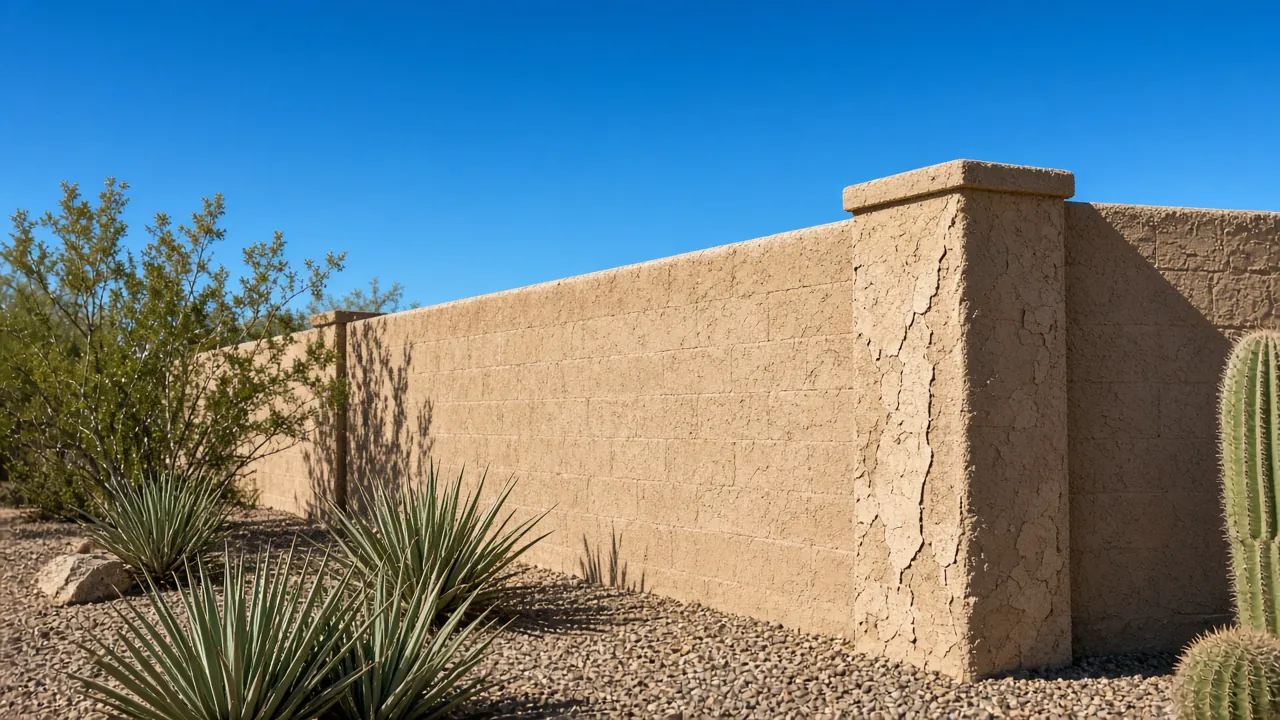
Quick answer: Stucco cracking on block wall columns is usually the wall and the column moving differently, with no control joint to give that movement a place to go. A flexible caulk can hold a hairline that is stable. Peeling at the column, a crack that reopens or rust at the cap needs the stucco cut back and often a mason, not another smear of patch.
Yard walls in the Valley are concrete block with stucco over them, and the columns or pilasters are where the finish lets go first. People want a flexible caulk or a patch and to be done. Sometimes that is the whole repair. A lot of the time the crack is the joint the wall should have had. Here is how to tell.
Why It Shows Up at the Columns
A column is stiffer than the panel of block between columns. When the temperature swings from a cold morning to a west-facing afternoon, and when the soil under a long wall shifts a little, those two pieces don't move as one. Stucco is rigid. If it runs across that line with nothing to break it, the crack picks the line for you. You see it as a vertical split at the column, often on both edges, and the finish starts to peel there because water follows the split.
The Portland Cement Association's repair guidance says control joints belong at movement joints in the substrate and that lath should not run continuous across a control joint. It also separates static cracks from moving ones. A static crack can be filled. A moving crack is doing the job of a missing joint. Fill it with something rigid and it opens again beside the patch.
On block, the Florida Lath & Plaster Bureau's stucco-on-block bulletin makes a related point: stucco that is bonded to block should be jointed where the block wall itself has control joints. Where block meets a different kind of construction, a control joint is how you pre-place the crack you would otherwise chase. A poured or heavily reinforced column against a standard block panel is that kind of change in stiffness, even when both are "masonry."
A few other causes pile onto the same spot.
- A cold joint. The plaster crew stopped at the column and came back later. That seam was never knitted and it opens along the column edge.
- No control joint in the original job. The wall was coated as one sheet. The first summer did the layout the crew skipped.
- Irrigation and efflorescence at the base. Sprinklers wet the bottom of a block wall every day. Salts come through, the bond gets soft and the peel starts low and climbs the column where the water sits. Fix the spray or the patch fails at the bottom again.
- Rust at a cap or at steel in the column. Steel that rusts expands and pops stucco off in sheets. A flexible caulk on top of that flake does not stop the steel.
- A rigid patch over a moving crack. The patch looks fine in April and splits by August. The crack was the relief joint. Covering it moved the crack an inch to the left.
Hairline cracks that stay put are a different conversation from this pattern. When to worry about ordinary stucco cracks is in stucco cracks in Scottsdale. Column cracks that peel are the version that keeps coming back.
When Caulk or an Elastomeric Patch Is Enough
Use a flexible repair when all of these are true.
- The crack is a hairline and it has not grown or branched since you marked it.
- The stucco around it is stuck. It doesn't sound hollow and it isn't peeling in sheets.
- The crack is not the vertical joint where the column meets the wall panel, or you have watched that line through a summer and it truly does not move.
- The sprinklers are off the wall and the base is dry.
- You don't see rust stains, a popped cap or stair-step cracks in the block joints themselves.
Then a flexible exterior sealant or an elastomeric patch made for stucco can close it. Route a moving hairline so the sealant has a real joint to sit in, the way the sealant maker describes, instead of buttering a skin across the face. PCA notes that a glossy sealant line will show on a textured wall. A light broadcast of sand while it is wet can knock the shine down. Coat a wider area if you need the color to blend, not a postage stamp of a different paint.
Mark the ends of the crack and look again after the hot months. If it opened past the patch, it was a movement joint and the caulk was a test, not the repair.
When the Stucco Has to Come Off
Cut it back when the finish is peeling, the patch sounds hollow or the crack at the column reopens every season. Take the loose material to stucco that is still bonded. If the bond to the block is gone, the repair needs a bonding coat or lath, not another layer on dust. Where the column meets the panel, put in a control joint and don't run lath across it. That joint is the point. You are giving the movement a straight line instead of a new crack through the patch.
Match the texture on purpose. A smooth smear on a sand finish is as visible as the crack was. The sequence for ordinary crack work, when it really is a crack and not a failed column joint, is stucco crack repair.
When It Is a Mason's Problem
Stop coating and call a mason if the wall itself is the issue.
- The wall leans or the column is out of plumb.
- Cracks stair-step through the block joints, not just through the stucco skin.
- The cap is split, the steel is rusting and the face is popping off in plates.
- You can see daylight through a joint or the column has separated from the panel.
A stucco patch on a moving or rusting wall hides the thing that will knock the patch off. The mason deals with the block, the steel and the joint. We come back when there is a stable wall to coat.
What the Cost Page Actually Lists
We don't publish a separate price for "one column." The ranges below are the ones on the stucco repair cost page and they are the only numbers we'll use here. A flexible seal on a few stable hairline cracks can fall in the hairline range. A column that needs texture matched after a real crack repair is closer to the moderate line. If stucco comes off a section and is rebuilt, the page prices a larger section by the square foot. A wall that needs a mason is not one of these lines.
| What you're repairing | Published range | Fits a column crack when | Doesn't fit when |
|---|---|---|---|
| Hairline crack sealing, up to 10 cracks | $300 to $600 | Stable hairlines, stucco still bonded | The column joint keeps opening |
| Moderate crack repair with texture match | $500 to $1,200 | A limited crack that needs the finish blended | Sheets of stucco are loose |
| Extensive crack repair | $1,200 to $2,500 | Many cracks on the wall, not one failed joint | The block is leaning or the steel is rusting |
| Small patch under 2 sq ft | $200 to $500 | A small pop that is still bonded around it | The peel runs the height of the column |
| Larger section | $8 to $12 per sq ft | Stucco is removed and replaced on a sound wall | You still need a control joint and nobody has planned one |
What to Do, in Order
- Photograph the column and mark the crack ends with a pencil. Check it after the hottest stretch. Growth means it is moving.
- Tap the stucco. Hollow and peeling means cut it back. Firm and hairline can be a flexible seal.
- Look at the block, not just the coating. Stair-step joints, a lean or rust at the cap go to a mason before any patch.
- Move the sprinklers. If heads wet the base, fix that before you pay for stucco. The salts and the soft bond will return.
- Don't bridge a moving column joint with rigid patch. Seal a stable hairline. On a joint that moves, cut back, bond or re-lath where the bond is gone and install a control joint.
- Match texture and keep irrigation off the cure. A good patch still fails if it is soaked every morning.
Checklist Before You Buy Caulk
- The crack is marked and you know whether it grew
- The stucco is bonded, not hollow or peeling
- The split is not a repeating column joint that acts like a control joint
- No stair-step cracks in the block and no rust at the cap
- The wall is still plumb
- Sprinklers no longer hit the base
- The product is a flexible sealant or elastomeric patch made for stucco, used the way the label says
- You have a plan to cut it out and add a joint if the caulk splits
If the column is already peeling, call (480) 405-4743 and send a photo of the whole pier, not just the crack. We'll tell you if it is a seal, a cut-back with a joint or a mason before we touch it.
Frequently Asked Questions
Will flexible caulk fix stucco cracking at a block column?
Only if the crack is stable, the stucco is still bonded and the column joint isn't moving. A crack that reopens needs a control joint, not another layer of caulk.
Why does the peel start on the column and not the middle of the wall?
The column is stiffer than the block panel, so movement shows up on that line. Water, a cold joint or a missing control joint makes the same spot peel.
When should a mason see the wall?
When the wall leans, cracks stair-step through the block joints or a rusting cap is popping the stucco off. That is the masonry, not the coating.
What do column repairs cost?
We don't publish a column-only price. Hairline sealing is $300 to $600 and a larger rebuilt section is $8 to $12 per square foot on our cost page.
Should I patch before I move the sprinklers?
No. Daily spray at the base softens the bond and brings salts back through the new patch. Aim the water off the wall first.